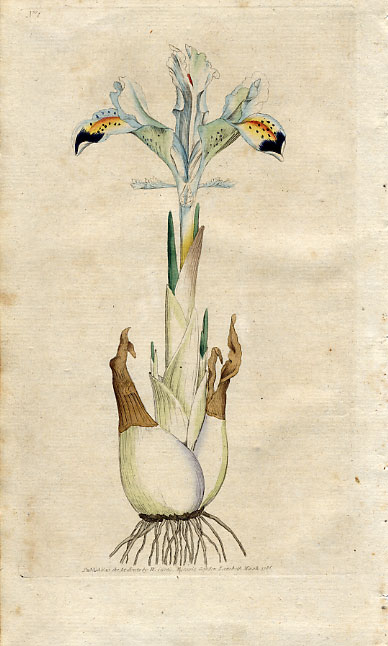
I ask because for some years I have been engaged in intensive study of the horticultural and literary history of Iris persica L. One of the odd things about all this, and one thing that started me on the subject, is the discovery that Iris persica was grown as an heirloom plant in some communities of the tobacco lands of the Upper South, including North Carolina, and Tennessee. Elizabeth Lawrence mentions it in A Southern Garden and there are other documentations of even great interest. For instance, Iris persica was in trade in Virginia before 1800, Now, almost as long as the history of Iris persica in the literature of horticulture, is the history of it being considered almost impossible to keep. I am much interested in this paradox.
I know that in the middle of the twentieth century some heirloom colonies of Iris persica still survived in North Carolina, probably around the Pittsboro area, maybe Raleigh, but I have not found anyone down there who knows anything about this plant today, and I have beaten many bushes and leaned on many connections.
As you may know, North Carolina has always been a good area for bulbs, indeed the USDA tried to get a bulb industry started down there at one point.
I have promised Rodney I will write all this up for SIGNA. I'm still doing some poking about. The traditional date of entry for the species into western horticulture is 1627 for Parkinson's Paradisi in Sole, but if an inquiry I have outstanding pays off--someone in Switzerland needs to get back to Italy over Christmas to check her notes for me --I may be able to document its presence in Europe much earlier in the century.
Meanwhile, I have one seedling of Iris persica, which has awakened after its summer domancy! It germinated last year, and now has a tiny bulb the size of a petit pois! How I hover over it, the little wretch! By Gawd, the Persian Iris, has returned to the Upper South!
So, that is why I asked. Just one of my strange preoccupations, I had so hoped someone had maybe given you a handful of bulblets from a family garden. They were quite a status symbol.You will want to keep your eyes out for them in February. The heritage plants were of the form which Sir Michael Foster called "typical", which is the form shown in the Botanical Magazine, as Plate 1. It may have been collected into extinction.
Cordially,
AMW
-----Original Message-----
From: Darlene Moore <dmoore@carolinarubber.com>
To: iris-species <iris-species@yahoogroups.com>
Sent: Tue, Dec 4, 2012 10:37 am
Subject: Re: [iris-species] Deer resistant iris
I sent for them from McClure and Zimmerman. I. Bucharica.
I have not seen them offered from any of the limited suppliers that I
know of.
Why do you ask?
Darlene
On 12/3/2012 5:15 PM, C*@aol.com wrote:
>
> Darlene, which Junos did you plant and where did you get them, please?
> Thanks.
> Cordially,
> AMW
>
> I
> just planted some Junos because I thought the deer didn't like any
> irises!
>
>
>
>
> -----Original Message-----
> From: Darlene Moore <d*@carolinarubber.com>
> To: iris-species <i*@yahoogroups.com>
> Sent: Mon, Dec 3, 2012 4:15 pm
> Subject: Re: [iris-species] Deer resistant iris
>
> Here in North Carolina zone 6A we have a terrible deer problem, but they
> have never touched my siberians, germans, virginias or foetidissimas. I
> just planted some Junos because I thought the deer didn't like any irises!
>
> Darlene
>
> --
>
>
--
Darlene Moore
Carolina Rubber & Specialties, Inc.
Phone: 336-744-5111 Fax: 336-744-5101
Email: d*@carolinarubber.com