Mornin', Walter et all,
with my experiments, it was not simply Iris, aril or otherwise, but
many different genera. The key problem is the higher temps combined
with insufficient light. This leads to faster growth after
germination which cannot be properly supported by the possible
photosynthesis. Yes, one could simply increase the light amount,
but this is a very costly road, especially in Europe where our
charges are about 3-10x what one pays in the USA, and, I have not
found the end result warranted the extra effort and cost. In short,
those seedlings I raised in a cold-house or cold frame managed to
quickly catch-up to those under lights and finally, as far as I
could observe, produced superior seedlings. My extra efforts were
wasted.
In a light laboratory, one does manage to obtail better seedlings,
again, higher costs, but part of the reason is the actual spectrum
of light used. A basic misconception is that what appears as strong
light to the human eye is strong for the plants. As most will
recall, photosynthesis for land plants is taking place mainly at
660nm (plus 720nm with some plants) and 420nm and 470nm. This is
essentially very red and very blue light. Actually at the edge of
our ability to register light as visible. Clearly, there are light
sources designed for plants, which respect these needs, but many do
not really offer the plants the best radiation, rather attempt to
appease the human eye and are emmiting lots of (useless) light in
the yellow-green part of the spectrum, which, not coincidentally, is
the peak of the human light experience. The colour of our sun! In
the end, we only have our eyes to judge lighting, unless we use a
spectrometer.
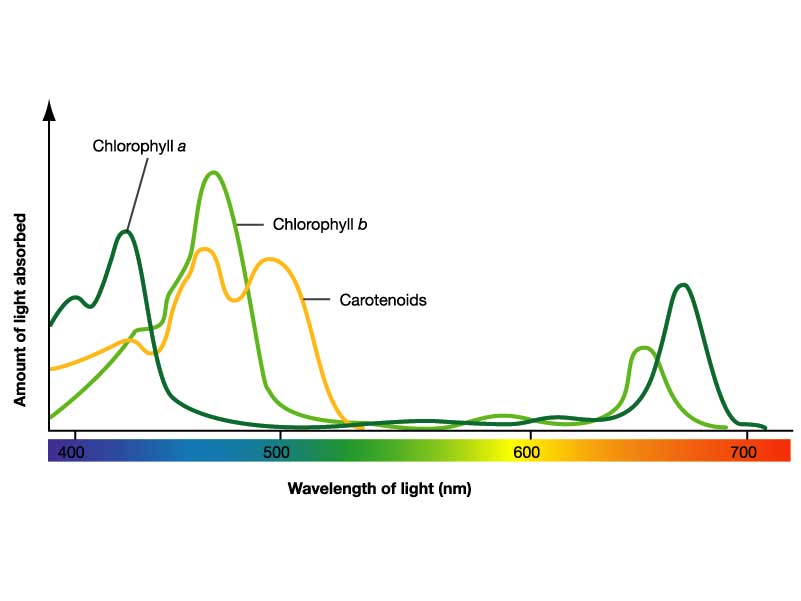
To give you all a better idea of the light involved, I have attached
a graph of chlorophyll light absorbtion. There are other
light-gathering pigments involved in certain plants, but for our
purposes, chlorophyll and caroteinoids are the main pigments
involved.
Another factor many do not know about is the life-span of
fluorescent light sources. After about 6 months they start to
strongly move to the yellow spectrum. After 9 months they are
pretty much useless for plants. Sodium is an option, but has a
similar deficiency and is less efficient at producing light, watt
for watt. The best light source would be top-line LEDs in the
proper spectrum. Again, we come to an economic factor, which is why
I have decided the natural light/coldframe approach was the winner.
One area I do find interesting for under light culture is giving
forced arils a good start. Here, lower temps are pretty important,
as none of them do much growing under high heat. Room temps are to
high, IMO. On a cold windowsill with supplemental lighting, I have
brought them to an intermediate size (second leaf or so) and then
transfered them outside to a cold frame.
ciao für now,
Jamie V.
Cologne
Am 04.12.2015 um 21:48 schrieb Walter
Pickett w*@yahoo.com [iris-species]:
So Jamie says he has
poor results growing new arilbred seedlings over winter
under lights, and Dennis says he has had good results doing
the same thing with LA iris seedling.
I respect both based
on what they have said over the years on the internet. They
both seem to know what they are doing. But I wonder if the
different results are due to the species they have worked
with, or on the amount of light or other conditions in their
light set-up.
Please keep us
informed of results, and if possible, describe the
conditions you are growing these seedlings in.
Walter
On Monday,
November 30, 2015 2:07 AM, "Jamie
j*@freenet.de [iris-species]"
i*@yahoogroups.com wrote:
Dennis,
nice! Have you considered potting them up
and over-wintering them in a coldframe? I
have found seedlings do very poorly inside
during Winter. They attenuate and often
become quite weak by Spring. In a coldframe
they growm more slowly, but we see a better
root system and compacter growth. Also,
roots continue to develope and grow when
temps are above 4°C, while the leaves
develope little, if at all, thus putting
energy into the basis of the plant.
What ever you decide to do, keep taking
fotos. Document for the rest of us!
cheers, Mate,
Jamie
Cologne
Am
30.11.2015 um 04:29 schrieb Dennis Kramb
d*@badbear.com
[iris-species]:
In August I started sowing my
iris seeds in ziploc bags with a little
bit of wet potting mix. I put them in the
refrigerator and checked them frequently
in the early weeks but then sorta forgot
about them. I just checked them for the
first time in over a month and there's a
lot of activity. Here are pics of seeds
germinating from the arilbred 'Rare
Breed'.
I intend to pot them up & grow
them under lights this winter and
hopefully keep them growing through
spring & into summer. I've
never tried this intentionally
before but I've done it
unintentionally with Louisiana
irises.
Dennis in Cincinnati