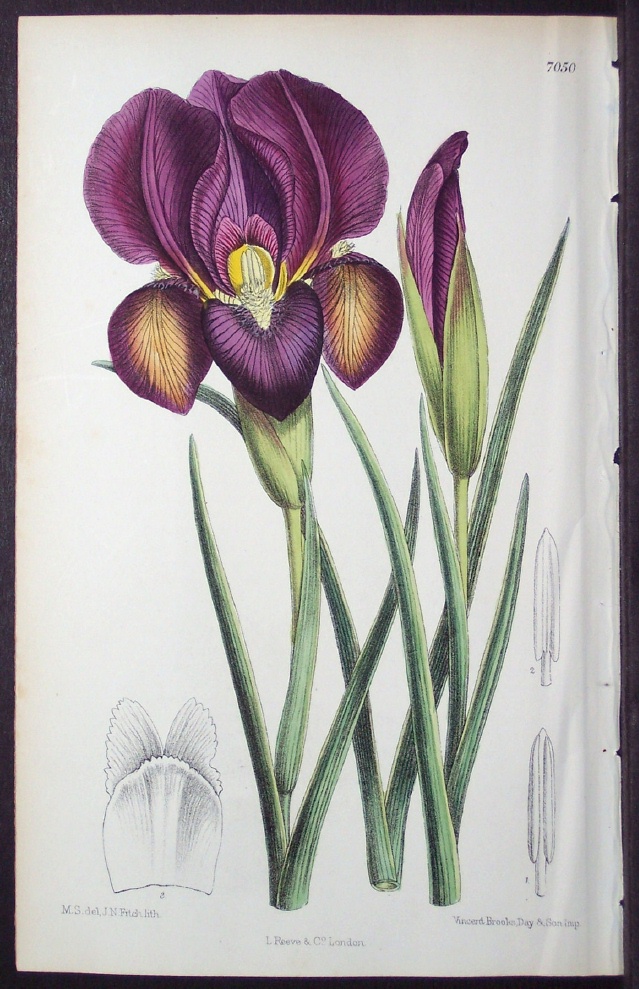
Here is the plate from CBM. It is not one of the great ones.
AMW
-----Original Message-----
From: Robert Pries <robertpries@embarqmail.com>
To: iris-species <iris-species@yahoogroups.com>
Sent: Mon, Feb 3, 2014 6:21 pm
Subject: Re: [iris-species] Iris barnum(i)ae
It seems taxomomists have always had a hard time with Botanical Latin. Much of which is actually Greek. Most taxonomists I know do not really care if it is one i or ii or ae or iae. It is essentially all the same. Baker a year later wrote about barnumae in Curtis' Botanical Magazine when he and Foster had originally used Barnumi the year before in Gardeners' Chronicle. Of course one can always find those exceptionally anal retentive personalities that are out to correct the world. Perhaps the Kew list has one of these but frankly the effort is not generally appreciated. Most scientists are after clear communication and every change generally disrupts that to some degree. There are lots of purists that insist on making Botanical Latin, Classical Latin, but the most important goal should be clear communication.
,
From: "JamieV." <j*@freenet.de>
To: i*@yahoogroups.com
Sent: Monday, February 3, 2014 3:00:27 PM
Subject: Re: [iris-species] Iris barnum(i)ae
I remember reading somewhere, a long time ago and, as I recall it was about orchids, which have masses on honourific names, that it was once typical to add the 'i' first and then the suffix. Thus we had -iae and -ii as typical. This may have been an effort to reflect correct latin declination with honourific declination. A masculine genus combined with a femimine honourific. This was changed to just adding the masculine or feminine, therfore -ae or -i are now considered correct. Of course, this change was not without conflict, but the modern school seems to be winning out. Quite a few genera are having their species adjusted to reflect the new terminology, as well as correcting what were mis-gendered situations. One that comes to mind is the genus Centropyge, which is now considered feminine. Species that previously ended with -us now end with -ae. I hardly think the fish concerned really cares, but
the change does correct a previous error in judgement. I suppose we could see this as a Linnean emmancipation!
This ring a bell with anyone?
Jamie
Am 03.02.2014 20:39, schrieb Dennis Kramb:
The ASI Checklist lists it as I. barnumae.
DK