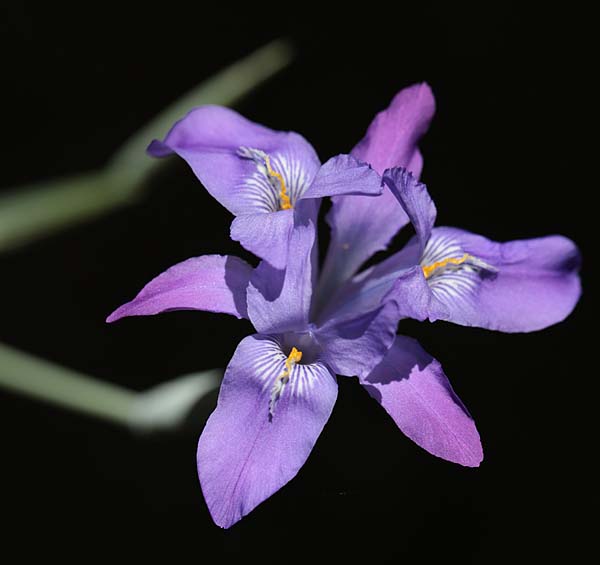
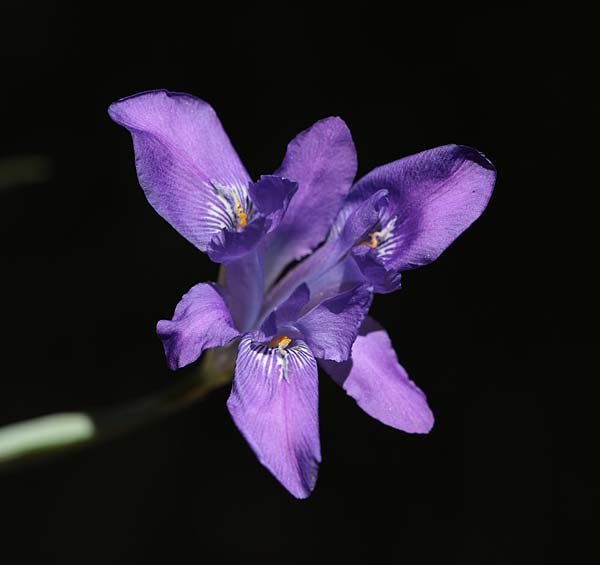
I'm attaching a couple photos of seedlings of Iris decora. Two years ago
I crossed a "typical" plant (as pod parent) with a "giant" plant (as
pollen parent). The typical plant was grown from seeds that came from
the NARGS seed exchange. It is likely of Chinese ancestry. The giant
plant came from seeds collected in Nepal, where other large plants have
been collected in the past. In addition to differences in bloom stalk
length, branching and leaf width, the Nepali blooms are somewhat smaller
and take a slightly different form from those of the typical plant. I
made the cross as an informal test to see how reasonable it is to lump
them into one species. The fact that the cross produced viable seeds is
encouraging.
I have 7 seedlings from the same cross, but just 2 are blooming this
year. The pollen parent is currently blooming profusely (too bad each
bloom lasts one afternoon). The first bloom on the pod parent opened
today, but I'm not sure I'll get much more than that this year. I also
have one seedling each from Nepali plants from 2 different collection
locations (the pod parent is the same).
Even with hand pollinating, if you don't remove the anthers before they
ripen, there is a small risk of self-pollination. Although I think it is
small for this species. The stalk on the first plant is slightly longer
than a long stalk on a typical plant. The bloom is intermediate in size
although the form is closer to the typical plant [I like the two tone
effect contrasting the falls with the standards]. The stalk on the
second plant is at the upper limit of what I've seen on a typical plant..
I'd say its blooms are slightly closer in form to those of the Nepali
parent when compared to its sibling. On both seedlings the leaves are
much closer to the width of a typical plant than two the Nepali plant.
Sadly, each seedling has only one branch rather than the more extensive
branching of the pollen parent. All-in-all I'm quite confident that the
seedlings have the Nepali plant as a pollen parent.
The next question is "how fertile are the seedlings themselves?"
Ken