Jim,
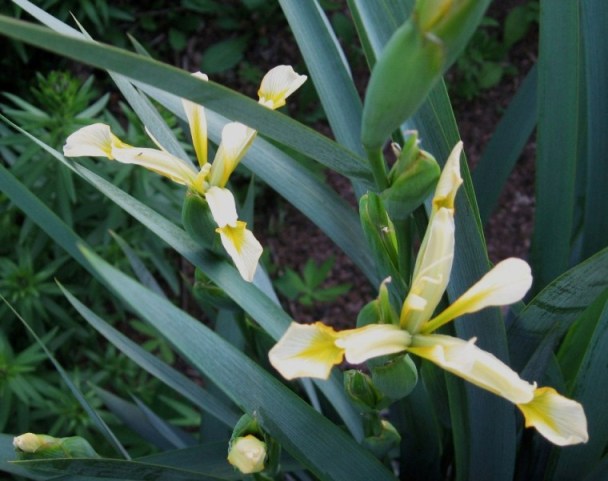
the height you give is quite tall for kerneriana. Typically it is half
so tall and considered a dwarf. You may have I. halophila, which
resembles I. spuria, but is generally robuster, often pale yellow/white
and does reach 30" or more. It should have 44 chromosomes, instead
of spurias 38. It blooms earlier than the other spurias, typically
with the tall beardeds.
Part of the reason many of these Iris are difficult to seperate is
their genetic variation. They appear physically similar, but are
genetically dissimilar. Apparently, as with many iris species, they
are actively evolving and speciating. At this point in time an
accurate reference is not available. One must search the library and
internet for bits of information and make an educated guess in most
cases. You should try crossing this plant with the possible I.
carthaliniae, also 44 chromosomes. If you get full pods, you at least
know they are compatable and genetically close. If there are few seeds
or no pods, then the ploidies are most likely different.
Hope this helps a bit,
--
Jamie V.

_______________________

Köln (Cologne)
Germany
Zone 8
gardenersfriend@sasktel.net schrieb:
This is still not the best of photos
of this iris, but it is the best I have right now. Yes, it is a large
plant perhaps three feet. Do you still think it might be I.
kerneriana? The leaves are fairly wide perhaps up to an inch in width
and the plant is tall around 30 inches.
Jim in Saskatoon