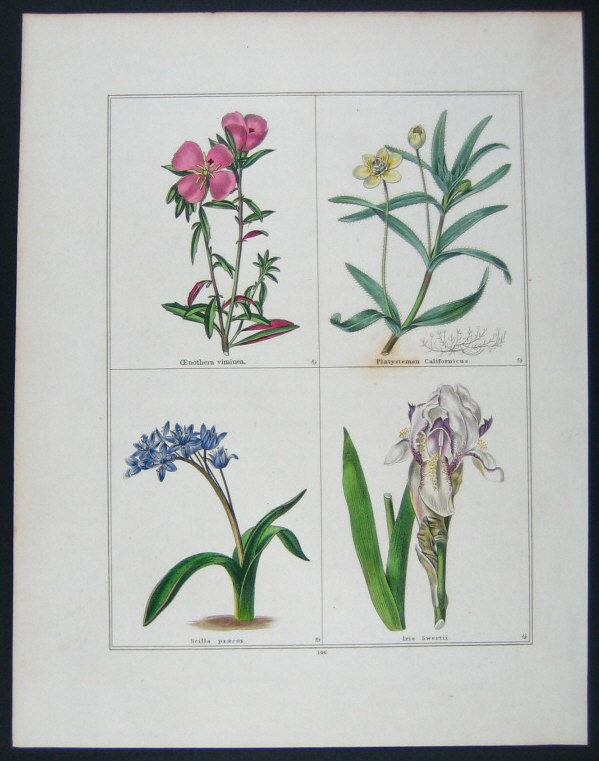
This was discussed in the HIPS journal ROOTS some years ago, with Dr. Art Tucker informally publishing his opinion that the preferred spelling should reflect what he believes to be Emmanual Sweert's own spelling of his name--------with two E's.
I'm sorry I don't have time rightn ow to run down that notice in ROOTS but that is the gist of it. I believe Art also addressed the question of the I's but I don't recall what he thought about that. If you do not have that issue to hand, perhaps Mrs. Lowe, editor at the time, can point you to the correct issue, so you can run it down and read it.
As you no doubt know, the1939 AIS Alphabetical Iris Check List styles the plant as a cultivar, states it is a collected plant, lists it as SWERTI, and cites the Florilegium as first reference. It also classifies it as a TB, meaning it bloomed at TB season, not necessarily at TB height. There are any number of other citations included in the entry which it might be interesting to collow up on. There is also an editorial note, "sometimes wrongly called I. aphylla." This comment doubtless goes back to all that aphylla bother in the Botanical Magazine, by way of Dykes, probably, which sources see.
Now, it must be said that the AIS became ICRA for non-bulbous Iris only in 1955, so that prior AIS check lists, so far as I understand, are accorded authority only as a courtesy, with, arguably, the exception of those entries arising from actual registration with the Society by hybridizers, into which category this iris does not fall. That said, as far as the definitive last word goes, the early AIS Check Lists are are pretty well the only game in town for sorting the historical material they address.
Venturing beyong these records, however, and off the top of my head, the earliest color plate I know of the plant---unless you want to thrash about in the aforementioned mess with Curtis' "aphylla"--- which I think is from 1805--- is from Maund's Botanical Magazine, circa 1835, see attached. Note the spelling on the plate. I intend to publish the Iris plates in Maund's at some point.
The AIS1939CL cites the 1823 catalog of the Prince Nursery in Long Island, NY as an early commercial source. Notes here indicate this catalog lists "Swert's Iberian, curious......[Iris] swertii." That is, with two I's. I am investigating the whole "Iberian" thing associated with this taxon, but have not gotten to the bottom of that particular mess yet.
To add to the fun, the Kew Checklist gives "I. swertii Lam." as a synonym of I. pallida v. pallida. This must have to do with "I. plicata."
So, to the best of my knowledge, the long-accepted name for this Iris generally and under the AIS umbrella of influence especially, is SWERTI, while some folks have thought it needed more vowels. It is up to you whether you think this needs to be addressed. For my part, I do not think so.
In my best understanding, absent any further persuasive information about its genetics, that this Iris is still best classified as a collected cultivar of unknown origin, not as a species, and not as a named form of any known species, so that the need of a formal corectly latinized scientific binomial really does not arise.
In fact, I think the rules actually preclude the use of any pseudoscientific Latinized names for horticultural forms.
Cordially,
AMW
-----Original Message-----
From: Tom Waters <irises@telp.com>
To: iris-species <iris-species@yahoogroups.com>
Sent: Sun, Oct 23, 2011 10:45 am
Subject: [iris-species] 'Swerti' spelling
Hello all,
A question for those into bearded species and historics. The cultivar 'Swerti' or 'Swertii' - which is the preferred spelling? My understanding of the conventions of Latinizing non-Latin names says it should be 'Swertii', but perhaps there is a tradition of usage behind the other spelling, which seems quite prevalent. Do earliest references favor one over the other? Any comments welcome.
Thanks, Tom