



Re: 'Swerti' spelling
- Subject: Re: 'Swerti' spelling
- From: C* C* <i*@aim.com>
- Date: Wed, 26 Oct 2011 10:34:44 -0400 (EDT)
|
I did try to get more details. But didn't get the details of what they obtained in terns of colours. But if they said ALL it may very well have included the plicata, as I found. I did take a count, but can't find the numbers right now. But nothing that had any pattern other then bicolour and amoena. I find the very dark colours interesting. Much darker then the mid pallida blue-violet of the pallida I used. Very different then Kuparii X reginea. Of note, all of the Kupari X reginea were of height of Kupari or perhaps even slightly taller. None short like reginea. I now have some F2 seeds collected this year. So can look at these in a couple of years, if all goes well. Did save about 5 plants from this cross. Ditched all the others. The Kupari X Sweertii produced all plicata. Some very light markings on petals but purple style arms. Only about 10 seedlings in this batch. Chuck Chapman From: ChatOWhitehall <ChatOWhitehall@aol.com> To: iris-species <iris-species@yahoogroups.com> Sent: Wed, Oct 26, 2011 9:24 am Subject: Re: [iris-species] 'Swerti' spelling I am sorry not to have time to run down the appropriate citations on this right now because I think this is important, but, unfortunately, I'm trying to get a coat of stain on a board fence before the rain gets here, so can only answer on the fly.
In this context someone needs to mention the early experiments by Dykes and Bliss along this same line. There are accounts in the garden literature of the time and Dykes says something brief about the project, too, in The Genus Iris.
By crossing variegata and pallida they succeeded in duplicating the several color forms which had long erroneously been called species--neglecta, squalens, sambucina, etc.---so that they were proven to be of hybrid origin, and if my memory is correct, they duplicated all the previously known color patterns generally, meaning, as I understood it, they came up with F1s identical to or very similar to most of the classic nineteenth century diploid cultivars. Then Dykes in one of his articles said something about a geographical area in which the distribution of the two species was tangent and intermediary forms of some description were found.
I don't recall whether the plicata pattern was specifically mentioned.
You may find it appropriate to investigate these seminal experiments.
AMW
-----Original Message-----
From: Chuck Chapman <i*@aim.com> To: iris-species <i*@yahoogroups.com> Sent: Mon, Oct 24, 2011 6:21 pm Subject: Re: [iris-species] 'Swerti' spelling I strongly suspect that what we know as Swertiii (or as cutivar "Iris sweertii) is actually a cross of I.pallida and I. variagata. It was discovered in a garden, not in wild.
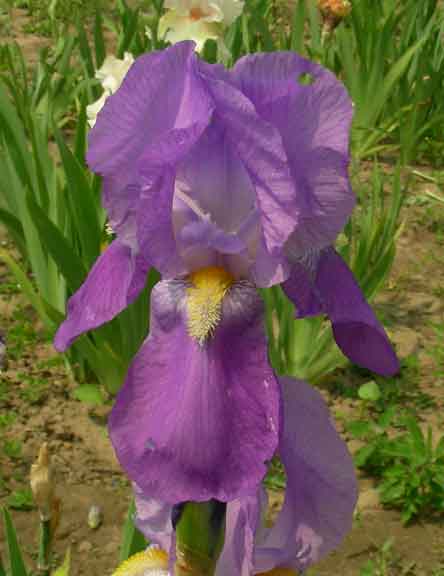
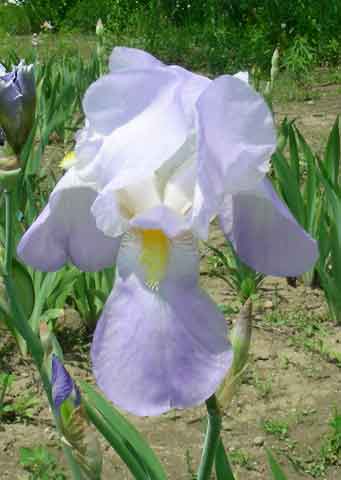
I'm preparing an article on an cross of I.pallida kupari and I. variagata regina, that gave a high number of plicata seedlings. All (100%) had papery pallida spathes. A few seedlings that could be called luminata-plicatas. Almost all seedlings produced seeds, but about 33% would not produce seeds from attempted crosses, but most of these did set bee pods. Here are two pics. One of a plicata seedling and one that resembles luminata-plicata pattern. Chuck Chapman From: Robert Pries <r*@embarqmail.com> To: iris-species <i*@yahoogroups.com> Sent: Mon, Oct 24, 2011 1:37 pm Subject: Re: [iris-species] 'Swerti' spelling Chuck; Iris swertii is no longer a valid species name since it is considered an Iris pallida. But the variation was described before we had cultivar designations or rules about them. The International code addresses this by saying this is no longer allowed, but names that were created before 1955 are conserved. There are many names in the 1939 Checklist which find themselves in this situation. They were both described as species by someone first and then decribed as a cultivar using the species name.
From: "Chuck Chapman" <i*@aim.com> To: i*@yahoogroups.com Sent: Monday, October 24, 2011 12:32:08 PM Subject: Re: [iris-species] 'Swerti' spelling As the cultivar called "Iris swertii" is a cultivar it shouldn't have a species name.
so Swertii or Swerti should be designation. Chuck Chapman ---- Original Message ----
From: JamieV. <j*@freenet.de> To: iris-species <i*@yahoogroups.com> Sent: Sun, Oct 23, 2011 12:57 pm Subject: Re: [iris-species] 'Swerti' spelling Interesting! As latin was typically used, one would expect it to take precedence over other descriptions, which may be only locally understood. Of course, there was that great confusion created by a certain German author that insisted on keeping his library closed away until after his death, leading to a great deal of synonomy. Perhaps this pushed the issue. Frankly, I find latin no more usefull than English, German, French, et al, as it is non-living and despite this fact, still 'evolving'!
Jamie Am 23.10.2011 18:40, schrieb C*@aol.com:
-- Jamie V. _______________________ KÃln (Cologne) Germany Zone 8 |
- Follow-Ups:
- Re: 'Swerti' spelling
- From: C* C* &*
- Re: 'Swerti' spelling
- References:
- Re: 'Swerti' spelling
- From: C*
- Re: 'Swerti' spelling
- Prev by Date: RE: 'Swerti' spelling
- Next by Date: Re: 'Swerti' spelling
- Previous by thread: Re: 'Swerti' spelling
- Next by thread: Re: 'Swerti' spelling