



more physics on roots
- Subject: more physics on roots
- From: &* D* B* <c*@bart.nl>
- Date: Tue, 10 Jun 2008 01:21:28 +0200
The discussion of glue on roots does remember me a special effect of
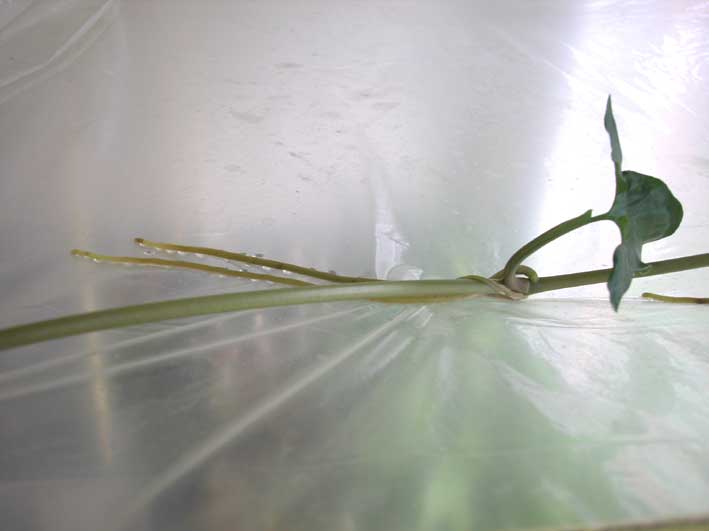
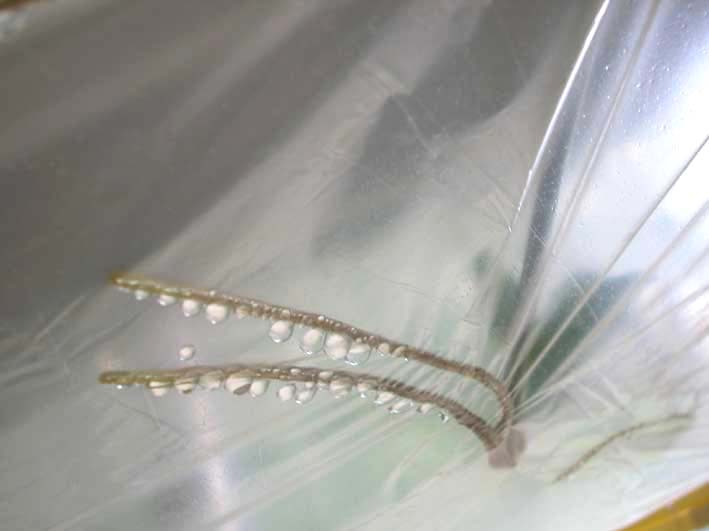
condensation I ever saw in my greenhouse. An ordinary, very weedy Syngonium
creeped over the plastic tent over my Cryptocoryne plants. In the tent the
RH is near 100%, outside the tent ca 70 - 80%. Temperature inside and
outside the tent is equal. Inside the tent there were a lot of water drops
on the plastic just under the glued climbing roots (see also the tension
folds in the plastic). So the roots are colder, very probably caused by
evaporation from the roots. Something I did not expect at least: wy should
climbing roots evaporate so much?

Jan Bastmeijer

___________________________________________________________________________
the crypts pages   http://www.nationaalherbarium.nl/Cryptocoryne/index.html
the lagenandra pages http://www.nationaalherbarium.nl/Lagenandra/index.html
___________________________________________________________________________


-----Original Message-----
From: aroid-l-bounces@gizmoworks.com [aroid-l-bounces@gizmoworks.com]
On Behalf Of Peter Boyce
Sent: Monday, June 09, 2008 9:35 AM
To: Discussion of aroids
Subject: Re: [Aroid-l] an apolgy if it is order


Hi Leyland,

Sorry for the delay in replying; just been the big Gawai holidays here so a
bit tied up with drinking tuak and eating wild boar.

Root glue occurs in the feeding roots all Asian genera (but not all the
species of each genus) of the Monstereae (e.g., Amydrium, Rhaphidophora,
Scindapsus & Epipremnum), in Anadendreae (Anadendrum only) and in Pothos and

Pedicellarum of Potheae. It is visible as a cap of 'gel' on the active root
tip. The most striking 'caps' are found in the Hookeri complex of
Rhaphidophora (R. hookeri, foraminifera, puberula, todayensis) in which not
only do the active tips of the feeder roots have a very substantial cap but
the climbing roots arise in masses along the stem and produce copious
quantities of gel/slime that not only glues the roots to the climbing
surface but also seems to provide an ideal environment for additional root
development such that pulling one of these from the tree often removes a
fair proportion of the adjacent bark.

Shoot disarticulation so far is found in the Asian rheophytic genera. I have

also observed (in cultivation) the same in W Africa rheophytic Anubias but I

have never been to W Africa and so cannot say whether other African
rheophtyes (Nephthytis, some Cercestis) have disarticulation mechanics.

Very best

Pete

----- Original Message -----
From: "brian lee" <lbmkjm@yahoo.com>
To: "Discussion of aroids" <aroid-l@gizmoworks.com>
Sent: Tuesday, June 03, 2008 5:18 PM
Subject: Re: [Aroid-l] an apolgy if it is order


> Dear Peter,
>
> Aloha.  Thank you for answering Steve's inquiry with
> this interesting set of observations....do you know of
> root glues or stem disarticulations in other plant
> genera?  What other botanical life history secrets can
> you share?
>
> Aloha,
>
> Leland
>
> --- Peter Boyce <botanist@malesiana.com> wrote:
>
>> Hi Steve,
>>
>> The root tip thing is very interesting. While up at
>> Batang Ai last week took some time to look closely
>> at a very common species of Piptospatha and realized
>> that the active root tip was always coated in cap of
>> viscous gel; looking at root development it dawned
>> on me that the gel was acting as an adhesive; as the
>> root progressed across the rock the gel cap laid
>> down a thin film, much the same as a slug or snail
>> does, and the developing root hairs bound into this,
>> gluing the root to the rock to the extent that
>> attempts to remove older portions the root actually
>> removed fragments of the rock (shale).
>>
>> The shoot tip thing is that the active shoot is
>> attached to the older part of the stem by a line of
>> weakness that functions as a point of potential disarticulation. When
>> the river flow becomes to great such that the drag on the leafy
>> portion has the potential to dislodge the entire plant, the
>> leafy shoot breaks at the point of weakness and thus
>> by sacrificing the active shoot/s the plan is able
>> to reduce drag and thus prevent total dislodgement.
>> The stumps remaining readily re-sprout, often
>> forming multi-headed plants. Aside from 'saving' the
>> mother plant the 'lost' active shoot tips frequently
>> end up in a suitable environment for
>> re-establishment and thus act as dispersal units.
>> Another interesting aspect of this process is that
>> the disarticulation point 'moves' with the extension
>> of the active shoot and thus only the same size
>> piece of active shoot is shed each time.
>>
>> Very best
>>
>> Pete
>>   ----- Original Message -----
>>   From: ExoticRainforest
>>   To: Discussion of aroids
>>   Sent: Monday, June 02, 2008 7:19 PM
>>   Subject: [Aroid-l] an apolgy if it is order
>>
>>
>>   Pete, this message from you is more valuable than
>> I can make clear. I have several mentors who are my
>> honest-to-goodness heroes and friends.  And I hope you know you are
>> one.  Tom, Simon, Eduardo, Alistair, Julius, Leland and many others,
>> a list too long to mention, help me all the time!  My goal has
>> been only to self-educate myself and to try to share
>> what I learn in a way anyone interested in aroids
>> can utilize.  I am a writer who has been putting
>> words on paper for over 30 years.  But without
>> accurate sources there is nothing to write!
>>
>>   You have answered my questions many, many times
>> and always help to make what I'm trying to
>> understand clear.  And that is at least in part the
>> reason I quote all of you rather than trying to put
>> what you teach in my own words.  As a non-scientist
>> my words are useless, but your words have value!
>>
>>   So thanks for your kindness and your continued
>> help.  With the same thanks to all the professionals
>> who teach me something new in their journals and
>> emails on virtually a daily basis.  If I could offer
>> advice to anyone who is interested in aroids it
>> would be to build a library of good scientific
>> material on the genus.  In the beginning the reading
>> is difficult, but I time you will begin to
>> understand the scientific terms and all those
>> questions become clear answers.
>>
>>   Now, a big request!  Tell us about "the way roots
>> glue themselves to rocks and how the shoot tips of a rheophytes
>> resist water flow in spate."  You just opened up a new file in my
>> brain and I want to know!
>>
>>   Steve
>>
>>
>>     Steve,
>>
>>     I live in a country where we constantly struggle
>> to get our students to read..... believe me...you
>> can NEVER read too much. I have worked with aroids
>> in one way or another for 30+ years; professionally
>> for 20+ years... I read about aroids, any aroids,
>> every day. And every day I learn something
>> new...this week so far I have learned something new
>> about pollination, the way roots glue themselves to
>> rocks and how the shoot tips of a rheophytes resist
>> water flow in spate. Tom, who has just tuned 70, has
>> worked on aroids for over 40 years... he reads every
>> day... Josef has worked on aroids nerly 50 years...
>> he reads every day... and I would bet that they too
>> are constantly learning new things.
>>
>>
>>
>>
> ----------------------------------------------------------------------
> --------
>>
>>
>>   _______________________________________________
>>   Aroid-L mailing list
>>   Aroid-L@www.gizmoworks.com
>>   http://www.gizmoworks.com/mailman/listinfo/aroid-l
>> > _______________________________________________
>> Aroid-L mailing list
>> Aroid-L@www.gizmoworks.com
>> http://www.gizmoworks.com/mailman/listinfo/aroid-l
>>
>
>
>
>
> _______________________________________________
> Aroid-L mailing list
> Aroid-L@www.gizmoworks.com
> http://www.gizmoworks.com/mailman/listinfo/aroid-l
>


_______________________________________________
Aroid-L mailing list
Aroid-L@www.gizmoworks.com
http://www.gizmoworks.com/mailman/listinfo/aroid-l
Attachment:
Syngonium_outside.jpg
Description: JPEG image
Attachment:
Syngonium_inside.jpg
Description: JPEG image
_______________________________________________
Aroid-L mailing list
Aroid-L@www.gizmoworks.com
http://www.gizmoworks.com/mailman/listinfo/aroid-l
- Follow-Ups:
- Prev by Date: Re: Structures on a Philo. spadix
- Next by Date: Re: : Philodendron sagittifolium at female anthesis!
- Previous by thread: Schismatoglottis species
- Next by thread: Root Physics and Disarticulated Anubias Roots