



Re: Iris germanica/AMAS
- To: <i*@yahoogroups.com>
- Subject: Re: [iris-species] Iris germanica/AMAS
- From: &* F* <m*@msn.com>
- Date: Sat, 10 Jul 2004 16:19:25 -0600
- References: <20040708213943.12022.qmail@web80007.mail.yahoo.com> <BAY11-DAV78BolVRExY00002bcb@hotmail.com> <001b01c465b4$0e22d920$fbc5bb44@ash.nc.charter.com> <40F0380F.60204@astound.net>
- Seal-send-time: Sat, 10 Jul 2004 16:19:25 -0600
|
Interesting stuff. I'm probably going to ramble a bit here, since I'm
just writing as my mind processes what you all have written, and as ideas pop
into my head.
Ken's picture (I like this clone) looks to me like a diploid I. pallida x
I. variegata hybrid or at least descendent. If If If appears very like the
I. "kashmiriana" clone that is in circulation; however, the bracts on that clone
are only partially papery. While most of these hybrids have an
intermediate condition of bracts to that of their parents (I. variegata is all
green, I. pallida is all papery), a number of hybrids, especially of later
generations, have bracts more like one or the other parent. It would be
interesting to get a chromosome count on this clone.
Early on (apparently until Dyke's work), there was a great deal of
confusion between I. germanica and these diploid hybrids, because they are
rather similar in gross morphology. Even Kohlein (quite recent) was not
fully clear on this distinction.
I have not seen many of the tetraploid TB "wild" clones alive and in
person, but none of the ones I have seen look like the one in Ken's photo.
They pretty universally have somewhat swollen (round looking), rather short,
foliaceous bracts that are papery only toward the tip (in varying degrees from
clone to clone). Some have purplish coloring on the bracts, most do
not. They have a very different form of the flower too, different
proportions, with the falls "hanging" down (implies that they are limp, but
they are not really). They also all seem to open from the bud in way that
is somewhat unusual among the wild species I've seen (though I need to observe
this more, since I first noticed it this year). The flower seems to open
fully before the falls fully unroll. In other words, the falls are
pendant, yet have loosely revolute margins often even into the third day (always
for the full first day). They also all have relatively slender stalks with
long branches that spread away from the stalk, giving them a very open look if
you are seeing only one stalk (when several are bunched together in a large
clump, it's not so obvious). The stalk height varies from about 20 inches
to 40 inches (seems a lot, but not unusual for a wild species to vary a lot in
height). The leaves are not ribbed. With most (all?), the leaves are
semi-evergreen (in my climate). I would need to check this, but it seems
they all have the "wavy" fan look, where the fans are not flat and two
dimensional, but have a slight "s" curve when you are looking down on them.
'Amas' seems to me just one of the pack, shorter than average, but not unusual
an any other way. In fact the clone of "varbossiana" I got from Lowell
Baumunk is very very similar to 'Amas', but is taller. I think I left the
name "varbossiana" off my list. It is not that old though, so is not much
of a contender for oldest name for the group. Kohlein has a photo labeled
as "I. varbossiana", I think it was from taken at Zagreb, and it is quite
different from my plant. It looks to be a diploid hybrid too. I
don't know if either is correctly identified, but mine (Lowell's) seems to be a
better fit.
I have not seen all of the plants of this group, but the ones I've seen
(several only as photographs), while somewhat varied, all look like one and the
same species to me, including I. trojana (assuming the 2 plants I've seen
are correctly identified). I would not consider any of the plants I'm
talking about to be hybrids of any sort, rather they seem to be pure wild
species. It is quite likely that I have a wider view of what could be
included in one species than many people. I have no problem with
variations in color, height, slight differences in how much of the bract is
papery, and so on. I've studied too many plant populations in the wild to
let measurements (unbacked by additional field observation) make the decision
for me.
My opinion, at present, is that most of the tetraploids from the ne. end of
the Mediterranean and eastward are probably representatives of one
species. In my bias, I would personally not even call it a highly variable
species; not from what I've seen so far. Rather, I'm amazed at how
many names have been given based on such minor variation! This sort of
naming is common with horticulturally popular plants though. There is also
evidence that some of these plants were scattered Eastward by civilization, but
have not tended to become naturalized quite the way the 44 chromosome hybrids
have (ie. perhaps I. belouini from Morocco and Spain?). This is part of
why I think these are the most likely "other" parent of I. x germanica (but
that's another discussion).
Of course, I'm just guessing on all of this. Unlike most plants I've studied, I have not had the opportunity to see these Iris in wild populations. I would love to do so some day. So, until I get that chance, I don't consider myself more than just an interested amateur, who may be way off base in his opinion. I really need to see what sort of variation is present in wild populations, and to see them over their entire wild distribution. With the politics of the region, and my usually empty wallet, it seems unlikely that this is going to happen for me. I probably won't be the one to sort it all out, but I sure do enjoy talking
about it, and this discussion is very enlightening. I have learned more,
faster, through this group of people than I can imagine through any other
venue. Too bad there aren't any people from where these Iris grow joining
into the discussion.
Now that the interest seems to be on the rise again, maybe we call get
living collections of all these plants together for comparison?
As for the name I. germanica, the name is tied to the type description and
specimen, no exceptions. If the type specimen is the tetraploid type, then
we automatically have our name (at least for the ones that are definitely the
same). If it is indeed the 44 chromosome type hybrid, then the name is
totally out of the running for the tetraploid species. It can't be both
(even though one could be the parent of the other). It does not have to be
republished as a hybrid name if the specimen is found to be a hybrid. The
"x" is just added to the name to indicate hybrid status. All hybrids with
the same parentage would be called I. x germanica, but not all 44 chromosome
hybrids would necessarily share the same species as parents (especially modern
ones, which probably have several species in their genome). I. germanica
became a valid name the day Linneaus published it, and it doesn't matter what
the plants turn out to be, the name will stand as a valid name for those plants
it was applied to. One thing for sure, no matter what it turns out to
represent, it will be the oldest valid name for that sort of plant.
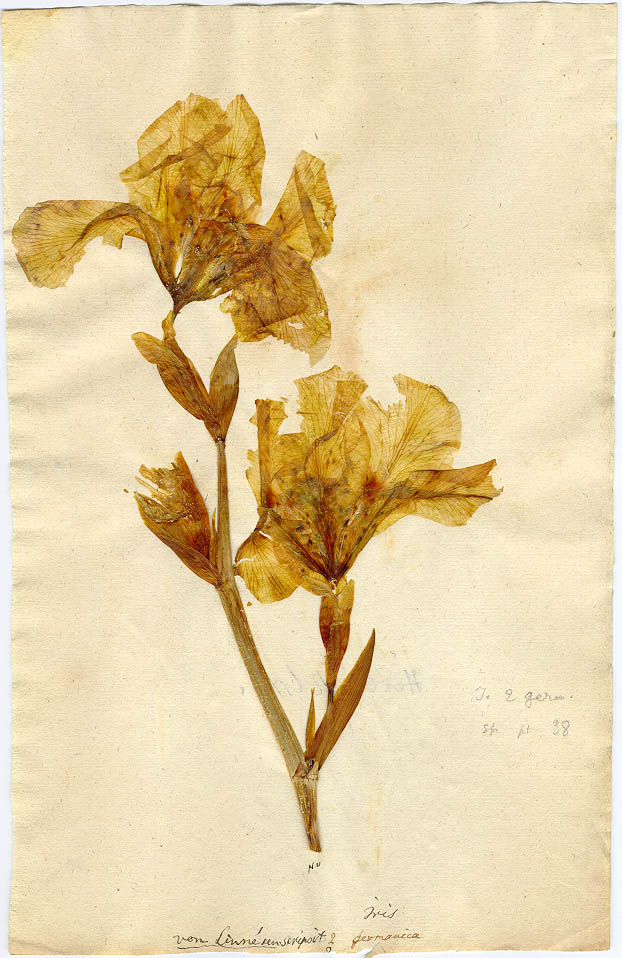
Here is a link to what might be the type specimen of I. germanica; however,
without a bit more digging into the literature, I'm not certain if it really is
the type. It is a plant that Linnaeus saw, and he included it under the
name I. germanica. It looks to me like the 44 chromosome type, but it
would be really difficult to be sure.
Here's an interesting thought. I know that chromosome counts are
routinely taken from dried invertebrate specimens. I wonder if this could
be done with the type specimen of I. germanica? It would answer a lot of
questions, and of course it would pose new questions.
Not from this discussion, but I think leading to it? Here is a
Linnaeus specimen of I. sambucina. I did not find one of I. squalens,
though it should theoretically exist.
-----------
Funny, all this started with my interest in learning the botany of the Iris
I love to grow. I had no idea there were so many questions in need of
answering still.
Dave
Yahoo! Groups Links
|
- Follow-Ups:
- Iris germanica - Greek
- From: K* W* &*
- Iris germanica - Greek
- References:
- Iris germanica/AMAS
- From: R* R* P* &*
- Re: Iris germanica/AMAS
- From: &* F* &*
- Re: Iris germanica/AMAS
- From: &* A* M* &*
- Re: Iris germanica/AMAS
- From: K* W* &*
- Iris germanica/AMAS
- Prev by Date: Re: Iris germanica/AMAS
- Next by Date: Re: Iris germanica/AMAS
- Previous by thread: Re: Iris germanica/AMAS
- Next by thread: Iris germanica - Greek